


June 14, 2026 – near La Sauve to near Morizès – 32 kms – L’Atelier des Rêves
June 15, 2026 – near Morizès to near Caument-sur-Garonne – 34 kms – Les Terrasses des Mimosas
June 16, 2026 – near Caument-sur-Garonne to Buzet-sur-Baïse – 26 kms – L’île aux Bateaux
Gordon: We have spent the past four days walking and riding on the Canal de Garonne. This canal connects with the Canal du Midi at Toulouse. Together, these canals are known as the Canal des Deux Mers, a 400+ kilometre link between the Atlantic Ocean and the Mediterranean.
There is a popular, mostly paved, bicycle route along the Canals. Ruth was in the minority cycling on the Chemin de Piémont Pyrénéen, but along the Canal I am the one getting strange looks, but friendly waves, as I proceed at my snail’s pace.
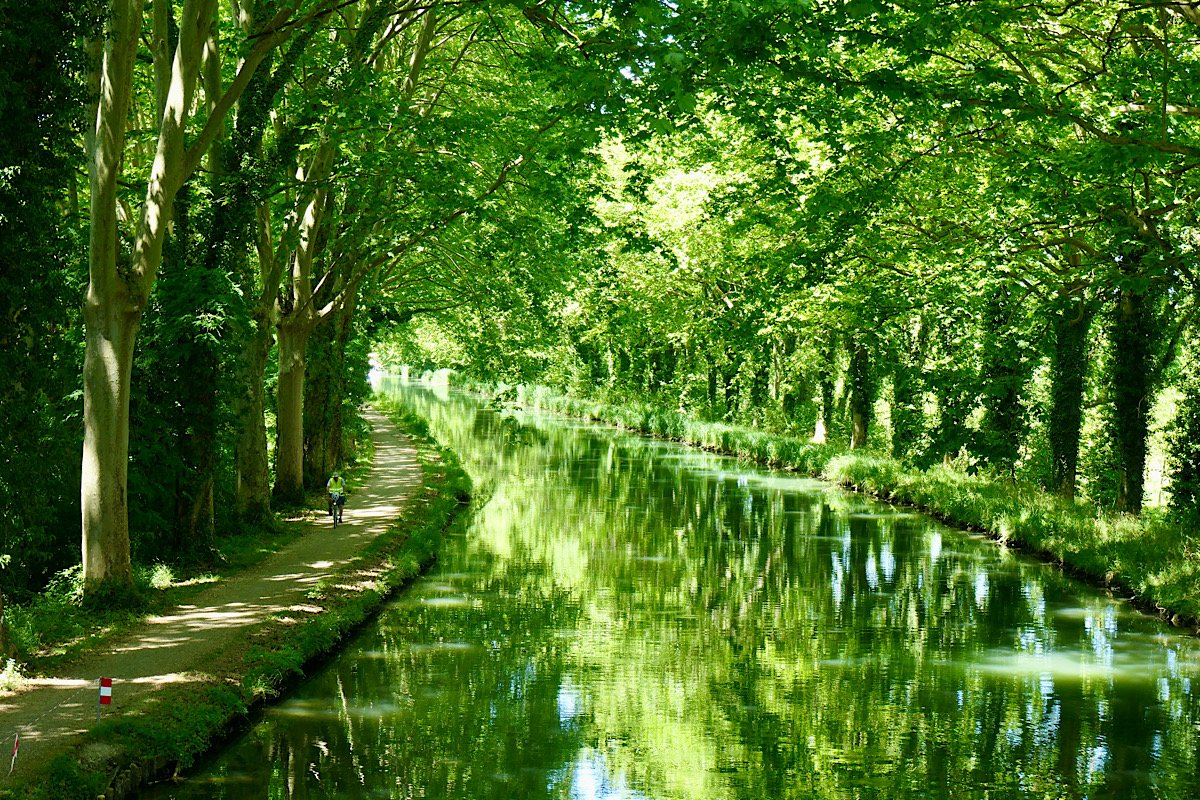
We are experiencing our second heat wave of the trip, but fortunately following the Canal is one of the best routes to weather it. There is an almost continuous line of century-old plane trees providing deep shade, and the ribbon of cool water helps to reduce the temperature, creating a pleasant microclimate. On the brief occasions when we step away from our treed corridor I immediately start to wilt.
It is quite picturesque along the Canal. The tall, spreading plane trees meet in the middle, leaving us with the sense that we are proceeding up the endless nave of a flamboyant gothic cathedral. The corridor of trees, which is often three trees wide on each side, creates a linear forest that is full of birdsong. Bridges cross the Canal every few kilometres, and there is the occasional lock, with its associated lock house. There is a certain sameness to the bike path after a while, but I think I would enjoy walking the entire Canal des Deux Mers, if we had sufficient time remaining.
The Canal is a green tunnel, but it passes a number of villages every day. We generally do a little advance research to know which ones might be worth a diversion for a short visit. Notable on the list are the bastide towns. We have visited many of these on previous trips in France. I used to think of them as fortified medieval towns, but their origin is a bit more complex. They actually formed a new pattern of settlement during the 13th and 14th centuries. Bastide towns were laid out in a grid pattern with a market in the centre. They were designed to foster trade by bringing groups of merchants together in a safe and regulated environment. The fortifications that I associated with bastide towns came later, as the insecurity of the 100 Years War and the later religious wars increased the need for fortifications.
We have determined that we have enough time to walk and ride to Moissac, a city we have previously visited at the end and subsequent start of previous pilgrimage walks. It would actually be possible for Ruth to ride to Toulouse from there in a long day, but she has decided to take the train with the old, slow guy. Besides, with temperatures forecast to peak at 41 degrees in Toulouse, a long bike ride seems unappealing.


Oh Les tournesols!